
ARTICLES

Magnesium Forms: The Key to Developing Differentiated and Value-Added Dietary Supplements

Magnesium is a vital mineral that consistently captures attention in the dietary supplement market due to its role in over 300 bodily processes. These include the nervous system, muscle function, energy production, heart health, and sleep quality. However, creating a “standout” product that truly meets consumer needs depends not just on the quantity of magnesium, but on selecting the right form for the product’s specific purpose and target audience
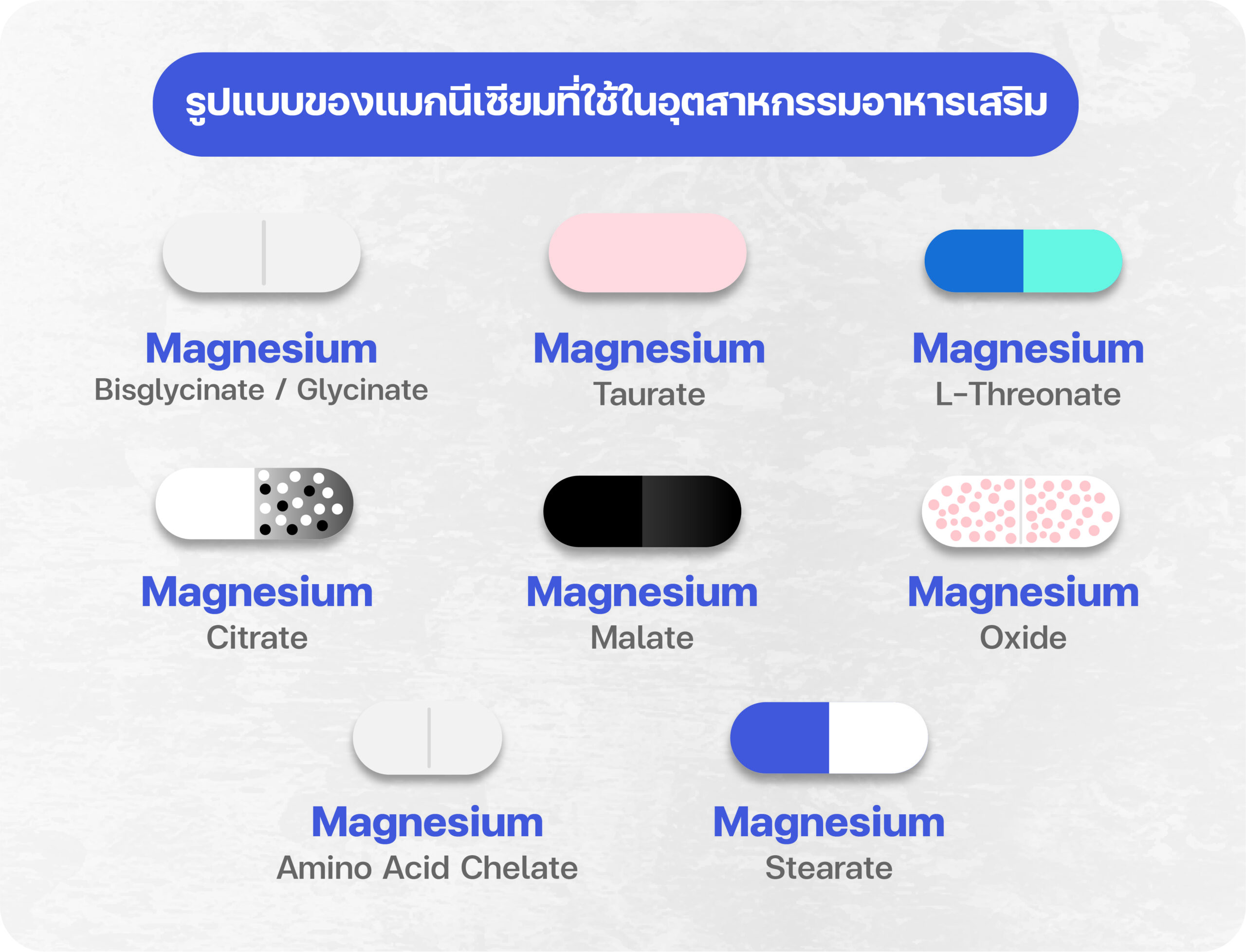



  1. Magnesium Bisglycinate / Magnesium Glycinate: A combination of magnesium and the amino acid glycine, which helps relax the nervous system. This form is suitable for individuals with sleep issues, stress, or muscle cramps. Its highlights include excellent intestinal absorption, being gentle on the stomach, and not causing diarrhea.
  2. Magnesium Taurate: A combination of magnesium and taurine, which plays a vital role in heart health and the autonomic nervous system. It is ideal for those looking to manage blood pressure, support heart function, and reduce smooth muscle spasms in the intestines. It offers better absorption than magnesium oxide or carbonate and is water-soluble.
  3. Magnesium L-Threonate: A form specifically developed to increase magnesium levels in the brain ($Mg^{2+}$) as it can effectively cross the blood–brain barrier. Research indicates it may play a role in memory, synaptic density, and cognitive function, making it suitable for brain and learning-focused products.
  4. Magnesium Citrate: Magnesium bound with citric acid, which has properties that draw water into the intestines, aiding moderate bowel movements. While it is well-absorbed, some individuals may experience loose stools more easily compared to glycinate or malate forms.
  5. Magnesium Malate: A combination with malic acid, which is involved in the cellular energy production process (Krebs cycle). It is suitable for those experiencing fatigue, exhaustion, or brain fog and is gentle on the stomach.
  6. Magnesium Oxide: The form with the highest elemental magnesium content but a low absorption rate (approximately 4%). Consequently, it is often used in formulas focused on laxative support rather than increasing systemic magnesium levels.
  7. Magnesium Amino Acid Chelate: Created by binding magnesium oxide with amino acids such as glycine and aspartic acid, resulting in better absorption than standard magnesium oxide. It is gentle on the stomach; glycine assists with relaxation and sleep, while aspartic acid plays a role in cellular energy production.
  8. Magnesium Stearate: A salt of stearic acid, commonly used as a flow agent and lubricant in the tablet or capsule manufacturing process. It is not used for nutritional magnesium supplementation.


Choosing the Right Magnesium to Create a Unique Selling Point (USP) for Your Product

The selection of magnesium for a dietary supplement formula is not merely a matter of cost or mineral quantity. Instead, it is a key strategy for establishing the product’s positioning. Whether the goal is a formula for sleep, brain health, fatigue reduction, or heart support, each form of magnesium offers unique strengths that can be effectively leveraged as powerful marketing communications.


Ingram Chemical Supply Co., Ltd. is ready to be your partner in raw materials and technical information, supporting entrepreneurs through every step—from selecting the appropriate Magnesium form and developing formulas to crafting a compelling Product Story. This ensures your products can remain competitive and achieve sustainable growth in the dietary supplement market.


Source
1. National Institutes of Health (NIH). Magnesium – Fact Sheet for Health Professionals.

  1. de Baaij JHF et al. Magnesium in Man: Implications for Health and Disease. Physiol Rev. 2015.
  2. Slutsky I et al. Enhancement of learning and memory by elevating brain magnesium. Neuron. 2010.
  3. Ranade VV, Somberg JC. Bioavailability and pharmacokinetics of magnesium after administration of magnesium salts. Am J Ther. 2001.